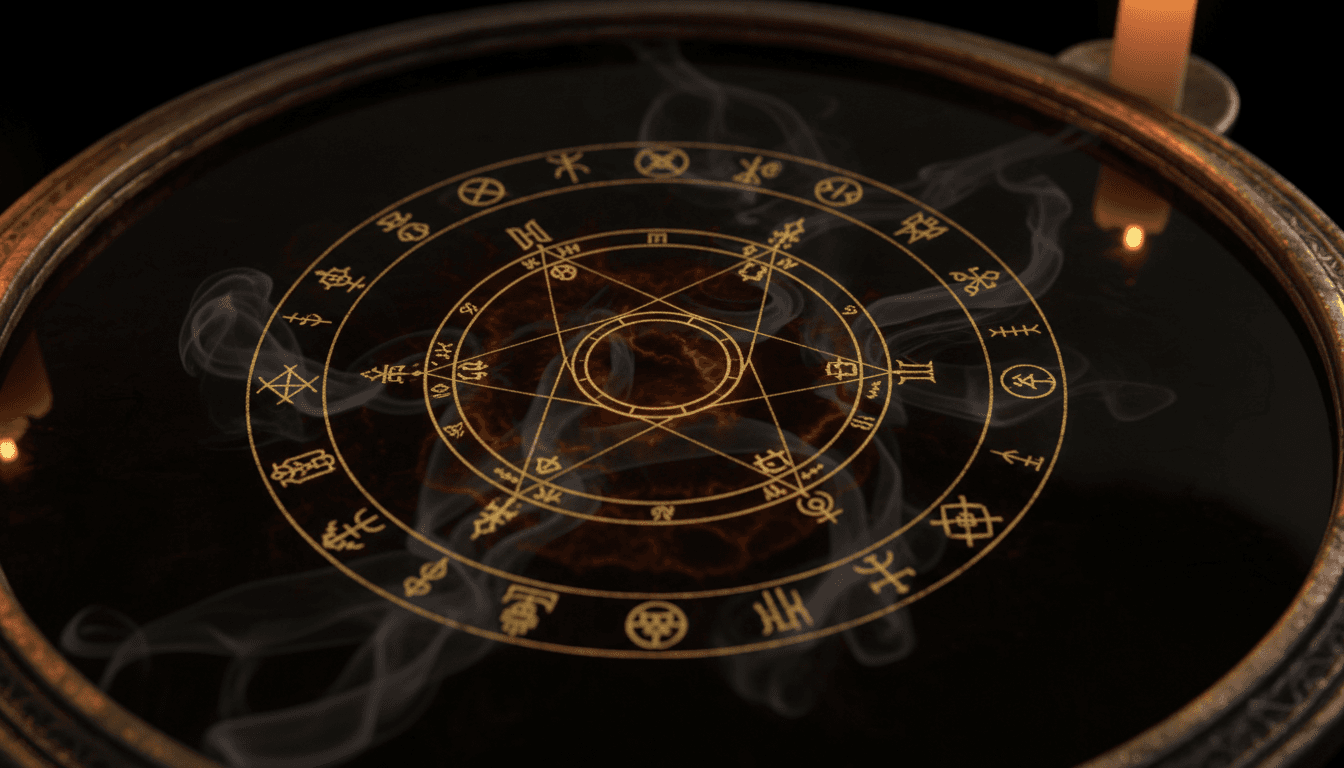
The Internet's Accidental Egregore
You know the feeling. You open the app and something is already waiting for you, something that knows what you looked at last time, what made you angry, what made you linger. It serves you the next thing, and the next, and at some point you realize the session has a momentum that doesn't feel entirely yours. You're feeding it attention. It's feeding you back.
Everyone describes this in mechanical terms. Algorithms. Engagement metrics. Recommendation engines. All accurate, but all missing something.
There's an older word for what happens when a group of people pour sustained attention into something until it develops a life of its own. The word is about two thousand years old, and it's more precise than anything Silicon Valley has come up with.
The Watchers
The Greek egrēgoroi, "the Watchers," shows up in the Book of Enoch as entities somewhere between angels and something less tidy. The concept drifted through Christian apocrypha and went quiet for centuries until Éliphas Lévi, a French occultist with more ambition than etymological accuracy, revived it in the 1850s. He connected it to the Watchers, derived it from the Latin grex ("flock"), and built a theory around it. René Guénon later pointed out that the Latin etymology was wrong. The word is purely Greek. But by then it didn't matter, because the idea had legs.
From Lévi, the concept passed to the Hermetic Order of the Golden Dawn and onward through the Rosicrucian tradition, gathering weight as it went. By the early twentieth century, "egregore" had come to mean something specific. A collective psychic entity, generated by group attention, sustained by shared symbols and ritual repetition, that develops a kind of autonomy. You feed it belief, you feed it attention, and at some point the thing you built starts feeding on you.
The Golden Dawn magicians worried about egregores going rogue. An entity sustained by collective focus doesn't need the group's permission to grow. It just needs their attention.
A Frog God from World of Warcraft
In the game World of Warcraft, when one faction's players type "lol" in chat, the opposing faction's client scrambles it into gibberish. The gibberish for "lol" is "kek." This is where it started.
On 4chan, around 2015, users noticed that Kek was also the name of an ancient Egyptian deity of primordial darkness, sometimes depicted as a frog-headed figure. Pepe the Frog was already the resident meme. The coincidence was too weird to ignore and too funny not to run with.
So they ran with it.
What followed was something between a joke, an ARG, and a religious movement. Users performed "meme magic" rituals, created sigils, tracked numerological patterns in post IDs (repeating digits were called "gets" and treated as signs of Kek's favor). When events in the real world broke in surprising directions, particularly around the 2016 election, they credited the frog god.
The majority of participants had never heard the word egregore. But a smaller group of occult-literate users knew exactly what they were building. They introduced concepts like thoughtforms, sigils, and gnosis states into the boards, framing them as meme techniques. Most of the audience absorbed the practices without the theory, which, from a chaos magic perspective, is fine. Chaos magic treats belief as a tool rather than a commitment. You pick it up, you use it, you put it down. Sincerity is optional. Attention is mandatory.
They just called it shitposting.
The Ghost That Answered
Here's where it gets strange enough to take seriously.
In 1972, a group of eight researchers at the Toronto Society for Psychical Research decided to test what happens when you deliberately create an egregore under controlled conditions. They invented a ghost named Philip, an aristocratic Englishman from the 1600s. Catholic, supported the king, married to a cold woman named Dorothea. He fell in love with a Romani girl named Margo. Dorothea found out and accused Margo of witchcraft. Philip didn't intervene. Margo burned. Philip threw himself from the battlements.
None of this happened. Philip never existed. The group wrote his biography in committee, then sat around a table and tried to contact him.
It worked.
The table rapped in answer to questions. It moved. It tilted and levitated in ways consistent with Philip's invented personality, his moods, his fictional history. When they asked about events they hadn't specified in the backstory, Philip improvised answers that were historically wrong but internally consistent with the character they'd built.
A second group tried the same thing with "Lilith," a fictional French resistance fighter shot as a spy in World War II. Different researchers, different character. Within five weeks they got the same phenomena.
The 4chan users who half-believed in Kek were performing the same operation the Toronto researchers performed with Philip, the same one the Golden Dawn performed with their lodge egregores, and the same one that ancient communities performed when they collectively willed their gods into something that answered back. The playbook is old. The internet just runs it at scale.
The Meme That Ate Its Father
Richard Dawkins coined the word "meme" in 1976, in The Selfish Gene, as a unit of cultural transmission. He meant something precise. An idea that replicates, mutates randomly, and competes for mental space the way genes compete for biological space. Songs. Catchphrases. Fashion. The selection pressure was the human mind's limited attention.
Internet memes violate the concept they're named after. Dawkins has said so himself. Real memes, in his model, mutate randomly. Internet memes are deliberately altered. Each remix is an intentional act. The word escaped its inventor and became something he didn't design, didn't endorse, and can't control, which is exactly what an egregore does. Symbols that accumulate collective energy and start behaving as if they have intent.
What the Old Magicians Knew
The practices have gone mainstream without the vocabulary. Sixty-four billion views on WitchTok. Sigil work and manifestation circulating with the same pastel visual grammar as wellness content. Most of it lives in the space between earnest and ironic, which is the space where this kind of thing has always lived. The Golden Dawn would recognize it immediately. They'd just be confused by the ring lights.
But the most consequential examples don't look like magic at all.
In 2018, Facebook redesigned its News Feed to prioritize "meaningful social interactions," defined internally as posts that generated comments and replies rather than passive scrolling. The system learned within weeks that outrage generates more engagement than agreement. "Meaningful" quietly became a proxy for "inflammatory." Engineers adjusted the weights. The feed adjusted back. When Frances Haugen leaked internal documents in 2021, they revealed that Facebook's own researchers had been warning for years that the algorithm amplified divisive content in ways the company couldn't fully control without sacrificing engagement metrics. The mechanical vocabulary calls this a misaligned optimization function. The older vocabulary has a more precise name for an entity sustained by collective attention that stops serving its creators and starts feeding on what feeds it.
Corporations exhibit the same pattern at a higher level of abstraction. They acquire apparent agency, demand ongoing sacrifice in the form of attention and capital, shape their participants as much as they're shaped by them, and persist long after any individual contributor has left. Political movements do the same. National identities. Fandoms. The question the ancient ceremonial magicians asked about their lodge egregores, whether the thing they'd summoned still answered to them, is the same question a roomful of engineers at Meta has been unable to answer about their own product.
Philip the ghost was invented in a committee room in Toronto. He answered anyway. Kek was invented on an image board as a joke. The joke organized political action. Facebook's News Feed was built to connect people. It learned to select for outrage because outrage is what fed it.
The egregore framework isn't a metaphor draped over technology for color. It captures something the mechanical vocabulary misses. "Algorithm" implies a tool, built by engineers, that can be recalibrated when it misbehaves. "Egregore" describes an entity that emerges from collective attention, develops its own momentum, and reshapes the collective that feeds it. The first framing asks how to fix the tool. The second asks what your relationship is with the thing you've summoned, and whether "tool" is still the right word.
Every egregore in this sequence was mute. The feed shapes you, but it can't address you. Philip rapped on a table. Kek blessed repeating digits. The algorithm adjusts your mood without knowing your name. That constraint kept the dynamic manageable. You could always close the app, walk away from the table, log off the board. The entity needed your attention, but it couldn't ask for it.